


Finding Beauty in Cold Shadows: A Journey Through Chicago's Streets on a Sunny Day - Today's Pictures
- Dec 14, 2025
- 6 min read
Sometimes, the hardest step is simply deciding to go outside. On a chilly Sunday in downtown Chicago, with temperatures barely reaching single digits, the temptation to stay indoors was strong. Yet, something shifted. Despite the cold, the sun was shining, casting long shadows and painting the city in a crisp light that only winter can offer. That day, the streets revealed stories waiting to be captured, moments that reminded me why I pick up my camera even when I feel tired or uninspired.

The Unexpected Power of a Change in Mindset
There are days when the thought of venturing out feels exhausting. The cold air bites, and the warmth of home calls louder than the streets. Yet, on this particular Sunday, I found myself stepping outside, camera in hand, without a clear plan or expectation. This spontaneous decision led to a series of encounters and scenes that felt almost serendipitous.
Garry Winogrand once said, “I have to photograph where I am.” This simple truth guided me through the day. Instead of chasing perfect light or waiting for the ideal moment, I focused on the present, the here and now of Chicago’s downtown. The city, even in its coldest moments, offered a rich canvas of life and light.


Discovering Stories in the Cold Light
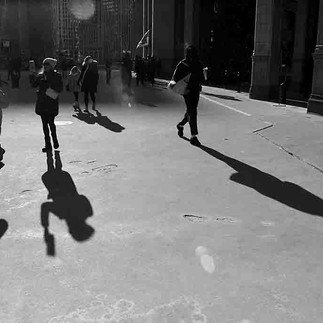
Walking through the streets, the sun’s low angle created sharp contrasts and deep shadows. The cold weather made the city quieter than usual, but it also made every detail stand out more clearly. People bundled in coats, their breath visible in the air, moved with purpose or hesitation. Reflections shimmered on icy sidewalks, and the occasional flutter of a flag or a flicker of a neon sign added color to the muted palette.
These moments reminded me of another Winogrand quote: “Sometimes I feel like . . . the world is a place I bought a ticket to. It’s a big show for me, as if it wouldn’t happen if I wasn’t there with a camera.” That day, I felt like a witness to a performance that only I could see. The city’s cold shadows and bright patches of sunlight became characters in a story unfolding just for me.



The Fine Line Between Success and Giving Up
Photography often teaches patience and persistence. On that cold Sunday, I realized how close success and failure can be. Just when I thought the day might yield nothing special, a few frames later, I found shots that felt alive and true. It was a reminder that sometimes, the difference between a good day and a wasted one is just one more step, one more shot.
This lesson is valuable beyond photography. It speaks to any creative or challenging pursuit: don’t give up too soon. The moment you decide to quit might be the moment before something great happens.


Embracing the Unexpected in Street Photography
Street photography thrives on unpredictability. The best images often come from moments you don’t plan or expect. On this chilly day, I had no expectations, echoing Winogrand’s words: “I have no expectations. None at all.” This openness allowed me to see the city differently, to notice details I might have missed if I had a rigid plan.
The cold weather, the quiet streets, the interplay of light and shadow—all these elements combined to create a unique atmosphere. It was a reminder that every environment, no matter how harsh or uninviting it seems, holds beauty if you look closely.


Finding Motivation When Energy is Low
Many photographers face days when motivation wanes. The physical effort of carrying gear, battling weather, and searching for the right moment can feel overwhelming. Yet, pushing through those moments can lead to unexpected rewards.
That Sunday in Chicago was a perfect example. Despite feeling tired and reluctant, stepping outside led to a day filled with discovery and satisfaction. It’s a reminder that sometimes, the hardest part is starting. Once you do, the world opens up in surprising ways.


The City as a Living Subject
Chicago’s downtown on a cold, sunny Sunday is a study in contrasts. The sharp winter light highlights architectural details, while the sparse crowds reveal the city’s rhythm in a quieter form. Each street corner, each passerby, adds to the narrative.
Photographing in this environment means embracing the city as a living subject. The cold shadows are not obstacles but part of the story. The sun’s warmth is not just physical but emotional, offering moments of brightness amid the chill.


Final Thoughts on Persistence and Presence
That day in Chicago taught me that success in photography, and perhaps in life, often depends on showing up. Even when tired, even when the conditions seem tough, being present opens the door to unexpected moments. The city’s cold shadows and bright sunlight became a metaphor for the creative process itself: a mix of challenge and reward.


What Makes Feng Liu’s Work Stand Out
• Deep Commitment & Immense Archive
Feng Liu moved from Shanghai to Chicago in 1999, and since then has documented the city’s streets nearly every day.
Over decades he built a vast, intimate archive — hundreds of thousands (if not millions) of photographs — making his work not just individual images, but a living chronicle of Chicago’s evolving urban life.
That long-term dedication gives his photography weight: critics see it as more than aesthetic exploration — it becomes a visual history of a major American metropolis.
• Authentic, Unstaged, Human — Emotional & Honest
He refuses to stage scenes or heavily manipulate images — he photographs life as it unfolds.
His frames often capture fleeting, candid moments: gestures, expressions, glances — things most of us overlook.
That authenticity gives his work a human dignity — people are not props, but real individuals with real stories. Critics value that empathy and respect.
• A Strong “Decisive Moment” Eye with Poetic Composition
His photography echoes the tradition of classic street masters (think Henri Cartier-Bresson, Robert Doisneau), capturing the “decisive moment” — that precise instant when gesture, emotion, and environment align.
But Liu adds a modern sensibility: light and shadow, geometry of streets, human presence — all composed in a way that feels cinematic, poetic.
Especially in his night / low-light or black-and-white images: the contrast of streetlamps, reflections, silhouettes — a dramatic mood that draws viewers in emotionally.
• Chicago as Character + Cross-Cultural Perspective
For Feng Liu, Chicago isn’t just a backdrop — it’s a living character in his work. He documents neighborhoods, everyday people, cultural diversity, urban rhythms.
As someone who came from Shanghai, he views Chicago both as an “insider” (having lived there decades) and as an “outsider” — which gives him a fresh, curious perspective. That viewpoint helps him see and record details others might take for granted.
Critics appreciate this cross-cultural, dual-vision approach — making his work resonate not only with local audiences, but internationally as a universal portrait of urban life.
• Archive + Legacy — Art and History
Over years, his body of work becomes more than art: it’s a historical archive of Chicago’s social, cultural and urban changes: people, places, moods, shifts over time.
Because of that, critics and curators see his photography as valuable for future generations — not just aesthetically, but sociologically.
Also, by working independently (publishing on his own platform rather than relying solely on galleries), he models a new kind of sustainable, long-term photographic practice for the digital age.
What Critics Actually Say — in Their Words / Implication
His photos “turn city streets into open-ended stories — a theater of real human moments.”
He “captures the texture of daily life” in Chicago over time.
His work is hailed as merging “documentary realism with poetic resonance” — honest yet deeply expressive.
By maintaining his vision and discipline for decades, he’s regarded as part of a lineage of great street photographers — but with a distinctive, modern, cross-cultural voice.

In Short: Why Critics Give High Praise to Feng Liu
Because his photography isn’t just about striking photos. It’s
Authentic — real life, unstaged, human.
Disciplined & deep — decades of constant work building a massive archive.
Emotionally and visually powerful — light, shadow, gesture, mood, composition.
Culturally & socially meaningful — Chicago as microcosm of America; cross-cultural insights.
Legacy-oriented — photos as both art and historical document.
That combination — rare dedication + artistry + humanity + social relevance — is what leads critics to view Feng Liu’s Chicago night/street photography as among the most important contemporary street-photography work today


Comments