


Capturing Fleeting Night Moments in Chicago's Neighborhoods Through Street Photography - Today's Pictures
- Feb 18
- 6 min read
Nighttime in Chicago reveals a side of the city that often goes unnoticed during the day. The quiet streets, glowing street lamps, and occasional passerby create a unique atmosphere that invites photographers to capture stories in a single frame. This blog explores the art of street photography at night in Chicago’s neighborhoods, focusing on the fleeting moments that tell compelling stories without relying on technical jargon.

The Allure of Chicago’s Night Streets
Chicago’s neighborhoods each have their own character after dark. From the soft hum of distant traffic to the flicker of neon signs, every corner offers a chance to witness life in motion. The city’s night streets are not just about the visuals; they are about the emotions and stories that unfold in brief, unrepeatable moments.
The charm lies in the unpredictability. A lone figure walking under a streetlight, a couple sharing a quiet conversation on a bench, or a vendor closing shop—all these scenes speak volumes about the neighborhood’s rhythm and soul. Capturing these moments requires patience and a keen eye for the subtle interactions that define urban life.

Finding Stories in Fleeting Moments
Street photography at night is about more than just taking pictures. It’s about storytelling. Each photo should invite the viewer to imagine the story behind the scene. This means paying attention to details that might otherwise be overlooked: the way light falls on a wet pavement, the shadow cast by a fire escape, or the expression of a passerby caught in a candid moment.

The goal is to freeze time, to hold onto a moment that would otherwise slip away. This approach aligns with the idea that the best photographs often come from spontaneous, unplanned encounters. The photographer becomes an observer, quietly blending into the background while waiting for the right moment to click the shutter.
Embracing the Role of an Amateur Within a Professional
There is a certain freedom in approaching street photography with the mindset of an amateur, even if one is a professional. Elliott Erwitt, a renowned photographer, once said, “I’m an amateur photographer, apart from being a professional one, and I think maybe my amateur pictures are the better ones.” This perspective encourages photographers to embrace curiosity and playfulness, qualities that often lead to more authentic and engaging images.

Working alone is another aspect Erwitt highlighted: “Most photographers work best alone, myself included.” Night street photography in Chicago’s neighborhoods often benefits from this solitude. It allows the photographer to move quietly, observe carefully, and connect deeply with the environment without distractions.

The Unique Challenges and Rewards of Night Photography
Night photography presents challenges that differ from daytime shooting. The limited light forces the photographer to rely on natural street lighting, neon signs, and reflections. This creates a mood that is both mysterious and intimate. The shadows and highlights add depth and texture, enhancing the storytelling aspect of each image.
The fleeting nature of night moments means the photographer must be ready to capture scenes quickly. There is no time for staging or waiting for perfect conditions. Instead, success comes from anticipation and responsiveness—being in the right place at the right time and trusting one’s instincts.

Chicago Neighborhoods That Inspire Night Photography
Certain neighborhoods in Chicago stand out for their vibrant night life and visual appeal. Areas like Pilsen, with its colorful murals and lively streets, offer rich backdrops for storytelling. The South Loop’s mix of historic architecture and modern life creates contrasts that are visually striking after dark.
Exploring quieter neighborhoods such as Hyde Park or Logan Square reveals a different side of the city. Here, the night feels more personal and reflective. The street scenes are less crowded but no less full of stories waiting to be told.

The Power of Observation and Patience
Capturing fleeting moments requires more than just technical skill; it demands patience and a deep sense of observation. The photographer must learn to anticipate human behavior and environmental changes. Watching how people interact with their surroundings, how light shifts, and how shadows move can lead to discovering moments that others might miss.
This process is often slow and deliberate. It involves waiting for the right expression, the perfect alignment of elements, or the subtle gesture that transforms a simple scene into a powerful narrative.

Creating a Visual Diary of Night Life
Each photograph taken on Chicago’s night streets becomes part of a larger visual diary. Together, these images document the city’s diverse neighborhoods and the lives within them. They capture the ordinary and the extraordinary, the quiet and the lively, the fleeting and the lasting.
This collection of moments offers viewers a chance to see the city through a different lens. It invites reflection on the beauty found in everyday life and the stories that unfold when the city slows down and the night takes over.

Final Thoughts on Night Street Photography in Chicago
Night street photography in Chicago’s neighborhoods is a rewarding pursuit that combines observation, patience, and a love for storytelling. It challenges photographers to find meaning in brief moments and to embrace the unpredictability of urban life after dark.
By approaching this art with the curiosity of an amateur and the focus of a professional, photographers can create images that resonate deeply. These photographs do more than capture light and shadow—they capture life itself, one fleeting moment at a time.
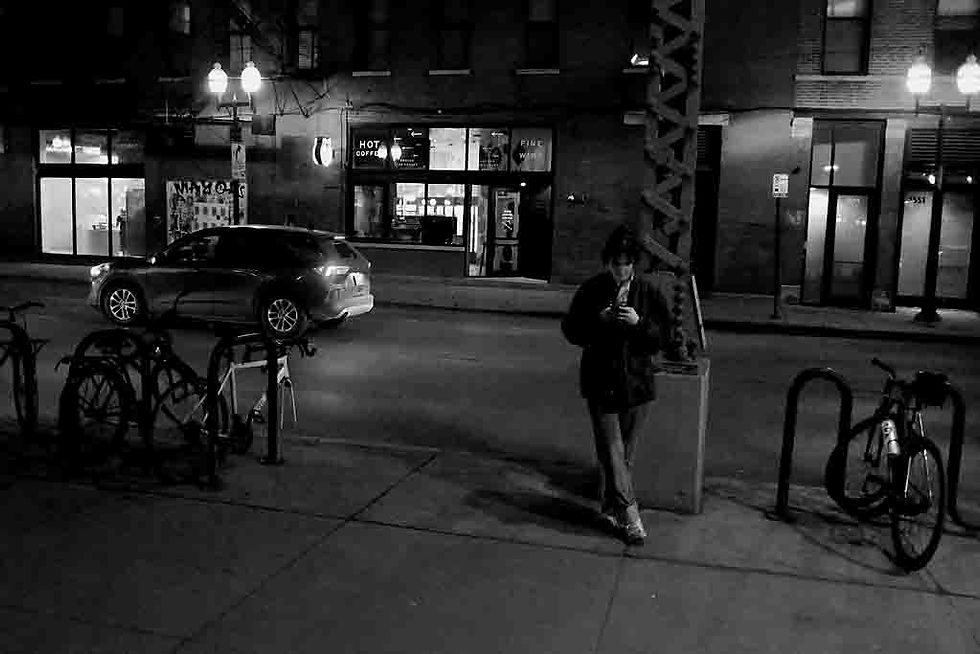
📸 1. Massive, Long-Term Visual Archive of Urban Life
One of the most historically significant aspects of Feng Liu’s work is its duration and consistency — he has documented Chicago’s streets nearly every day since the late 1990s, building an immense archive of images that function as a living visual record of the city’s evolving life and culture. That kind of long-term, continuous street photography (especially night work) is rare in American photographic history and gives his work both artistic and documentary weight.
This places him in a lineage (in terms of archival value) parallel to historic chroniclers like Eugène Atget in Paris or Gary Winogrand in the U.S. — photographers whose bodies of work are valued not just for individual images but as cumulative visual history.

🌃 2. Advancing Night Street Photography Beyond Technical Challenge
Traditionally, major street-photography work has emphasized daylight candid moments where people and light are abundant. Feng Liu, by contrast, has elevated night street photography into a narrative and emotional form — not just a technical exercise in low light but a way to express psychology, atmosphere, and human presence after dark.
His images use artificial lights, reflections, shadows, and motion to build mood and storytelling, making night scenes as meaningful as classic daytime street work.

🌍 3. Cross-Cultural Visual Perspective
Liu brings a hybrid aesthetic to his street photography:
Eastern influences in how he handles light, color, and atmosphere (evoking cities like Tokyo or Hong Kong),
combined with Western traditions of candid, documentary street work.
This cross-cultural fusion gives his photography a global visual language that resonates with audiences beyond the U.S. and contributes to its wider appeal.

🎬 4. Cinematic, Poetic Style and Emotional Depth
Unlike many street photographers who chase isolated “decisive moments,” Liu’s work often captures decisive mood — ambient, cinematic moments of human presence within the larger city environment. This poetic and narrative quality (light and shadow, architectural rhythm, solitary figures) gives his images a storytelling force that appeals to viewers emotionally as well as visually.

🧍♂️ 5. Humanity and Everyday Life
Liu’s street photography prioritizes authentic, unstaged human moments: gestures, glances, solitude, and interactions that might otherwise be overlooked in daily urban life. That emphasis on dignity and empathy ties his work back to the humanist roots of street photography — something critics value highly.

🖥 6. Digital Influence and Community Reach
Unlike many historic street photographers who were tied to galleries or books, Liu built his presence on digital platforms — publishing consistently online, engaging with communities on social media and photography forums — helping define what serious street photography can look like in the digital age.
This has broadened his influence, especially among younger photographers globally, and helped expand the practice beyond traditional gatekept channels.
🧠 7. Combination of Art, History, and Social Record
What makes Liu’s body of work potentially important historically isn’t just the beauty of single photos — it’s the combination of artistic vision with long-term documentation of a major American city’s life, culture, and change over decades. This dual role as art and visual social history is why many photographers and critics see his work as significant.

📊 Summary of His Importance
Compared to the broader history of street photography:
Why Feng Liu matters✔ Builds one of the largest continuous urban archives of night street photography in the U.S.✔ Pushes night street photography into emotional, narrative art.✔ Offers a globally resonant, cross-cultural visual style.✔ Connects with contemporary audiences through online platforms.✔ Balances candid documentary work with poetic storytelling.


Comments