


Capturing the Essence of Chicago's Night Streets: A Journey Through Fleeting Moments - Today's Pictures
- Feng Liu
- 13 hours ago
- 7 min read
Chicago’s neighborhoods come alive as the sun sets, revealing a different side of the city. On a Wednesday evening, when the week is still unfolding and the weather begins to warm, the streets offer a unique stage for life’s spontaneous moments. These fleeting scenes, often overlooked, tell stories of everyday people and the pulse of urban life. This is the heart of night street photography in Chicago—a pursuit of capturing the raw, unfiltered essence of the city after dark.

The Pulse of Chicago Neighborhoods at Night
As the temperature rises and the chill of winter fades, Chicago’s streets invite residents and visitors alike to step outside and engage with their surroundings. The neighborhood streets transform into lively corridors where conversations, laughter, and quiet reflections coexist. Street vendors set up their carts, couples stroll hand in hand, and late-shift workers make their way home. Each moment is transient, yet full of meaning.
The beauty of photographing these scenes lies in their unpredictability. No two evenings are the same. The light changes, the crowd shifts, and the stories unfold in real time. This is not about staging or manipulating scenes; it is about being present and ready to capture life as it happens.




The Art of Capturing Fleeting Moments
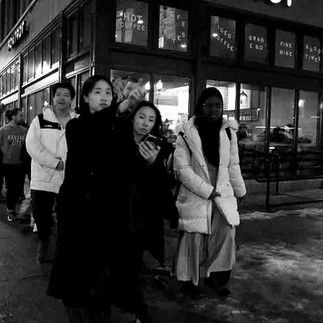
Street photography at night demands patience and a keen eye. The goal is to freeze moments that reveal something true about the city and its people. A man waiting at a bus stop, illuminated by a flickering streetlamp. A child chasing a stray balloon down a dimly lit alley. A group of friends sharing a quiet joke outside a corner store. These are the fragments of life that, when pieced together, create a vivid portrait of Chicago’s night streets.
The photographer becomes an observer, blending into the background, allowing the scene to unfold naturally. This approach respects the authenticity of the moment, avoiding any interference or artificiality. The result is a collection of images that speak honestly about the city’s character and the lives within it.


The Influence of Weather and Time on Street Life
Warming weather changes the rhythm of the streets. People linger longer outside, patios fill up, and the city feels more inviting. On a Wednesday evening, this shift is subtle but noticeable. The midweek calm contrasts with the weekend rush, offering a quieter, more intimate glimpse into neighborhood life.
The interplay of artificial light and the fading natural light creates a unique atmosphere. Neon signs glow softly, car headlights streak past, and shadows stretch across sidewalks. This lighting adds depth and mood to the photographs, enhancing the storytelling without altering reality.

Reflections on Authenticity and Life
The essence of street photography is captured in the honesty of the moment. None of the images are staged or altered. They are honest reflections of life as it is lived. This philosophy echoes the words of Jack Kerouac in his introduction to Robert Frank’s The Americans: the faces and scenes do not editorialize or criticize; they simply show life as it is.
This approach invites viewers to connect with the images on a personal level. The photographs become mirrors reflecting our shared humanity, with all its imperfections and beauty. They remind us that life is lived in moments—some joyful, some quiet, some fleeting—and that these moments deserve to be seen and remembered.




The Stories Behind the Streets
Every corner of Chicago’s neighborhoods holds a story. The night streets are filled with characters who might otherwise go unnoticed. A street musician playing a soulful tune, a vendor packing up after a long day, a lone cyclist navigating the quiet roads. These stories are not scripted but emerge naturally from the city’s rhythm.
Capturing these stories requires more than just a camera. It demands empathy and respect for the people and places that make up the urban fabric. It means recognizing the value in everyday moments and honoring them through the lens.



Embracing the Impermanence of Night Photography
Night street photography is a reminder of life’s impermanence. The moments captured are fleeting by nature—they exist only briefly before changing or disappearing altogether. This impermanence adds urgency and excitement to the craft. Each photograph is a small victory against time, preserving a piece of the night that might otherwise be lost.
This pursuit encourages mindfulness and presence. It teaches us to slow down and observe, to appreciate the beauty in the ordinary and the transient. It also challenges us to accept that not every moment can be captured, and that is part of the art.


Final Thoughts on Chicago’s Night Streets
Chicago’s night streets offer a rich canvas for those willing to look closely. The neighborhood life on a Wednesday evening, warmed by the changing seasons, reveals a city full of stories waiting to be told. Through honest, unposed photography, these fleeting moments come alive, inviting us to see the city through fresh eyes.


His Standing in the Street Photography World
*Yes — Feng Liu is widely regarded by many critics and photography communities as one of the leading contemporary street photographers in the U.S. and increasingly around the world.This reputation is based on several consistent points from critics, curators, and art commentators:
Artistic and Critical Recognition
Feng Liu’s work has been featured repeatedly in The Eye of Photography (Paris), a highly respected international photography platform, which has showcased his work many times (e.g., 16 features reported).
Critics and curators often place him among the greater living street photographers because of his visual style, discipline, and human storytelling.
Reviews describe his work as capturing candid, timeless moments and compare his “decisive moment” sensibility to that of historic masters.
Unique Qualities of His Work
He has built an immense, decades-long archive of Chicago street photography, documenting everyday life with high consistency and depth — a rare feat in contemporary photography.
His photos emphasize authentic, unstaged moments, emotional resonance, and visual storytelling that resonate both locally and beyond Chicago.
As an immigrant photographer, his perspective is described as blending cultural insights and universal human themes, helping his work appeal globally.
By many measures of critical respect (features, curatorial attention, influence on peers), Feng Liu is indeed regarded by many within the photography world as a leading contemporary street photographer — both within the U.S. and increasingly on the global stage.
What Critics and Communities Say
Recognition & Historical Importance
Liu has documented Chicago’s streets nearly daily for decades, building a massive visual archive of everyday life there.
His work is praised for extending classic street-photography traditions (like Cartier-Bresson’s decisive moment) into a 21st-century visual language with emotional, poetic and documentary depth.
Some critics explicitly place him alongside historic masters and emphasize that his archive will be studied and revered as part of street photography’s evolving canon.
Style & Influence
Reviewers note his cross-cultural sensibility (influenced by Eastern and Western aesthetics), cinematic use of light and shadow, and ability to capture candid human moments, especially in urban night and street scenes.
His daily online publishing model and global following (forums, social media, awards) give him influence in contemporary practice.
Feng Liu’s contributions to street photography are best understood not as a single innovation, but as a sustained, historically meaningful practice that expanded what street photography looks like in the digital, 21st-century urban era, especially in the United States.
Below are his core contributions, framed in terms that historians, critics, and serious photographers use.
1. Creating One of the Most Extensive Long-Term Urban Street Archives in the U.S.
Contribution:Feng Liu has photographed Chicago streets almost daily since the late 1990s.
Why it matters:
Few street photographers in U.S. history have maintained this level of consistency, duration, and geographic focus.
His archive functions as a visual social history of Chicago, similar in intent (though different in style) to:
Atget’s Paris
Winogrand’s America
This long-term commitment elevates his work from “strong images” to historical documentation through art.
This is one of his most important contributions.
2. Advancing Night Street Photography as a Narrative Form
Contribution:He significantly expanded night street photography as a storytelling medium, not just a technical exercise.
Why it matters:
Earlier street photography focused heavily on daylight spontaneity.
Feng Liu’s work shows:
Night as a psychological space
Artificial light as narrative structure
Solitude, ambiguity, and emotional quiet
His night images are not about spectacle, but about human presence within darkness.
He helped normalize night street photography as emotionally rich and artistically serious, not niche.
3. Blending Documentary Truth with Poetic Interpretation
Contribution:His work sits between pure documentary and poetic realism.
Why it matters:
He avoids staging, posing, or heavy manipulation.
Yet his compositions emphasize:
Gesture
Symbolism
Visual rhythm
This bridges classic traditions (Cartier-Bresson, Frank) with modern visual storytelling.
He shows that street photography can remain honest without being literal.
4. Humanizing Everyday, Non-Spectacular Urban Life
Contribution:Feng Liu focuses on ordinary people in unremarkable moments, especially outside tourist narratives.
Why it matters:
Much contemporary street photography favors shock, irony, or visual tricks.
Liu emphasizes:
Dignity
Quiet emotion
Psychological presence
His subjects are rarely caricatures; they feel lived-in and real.
This reinforces street photography’s ethical and humanist roots.
5. Establishing a Contemporary Digital-Era Street Practice
Contribution:He embraced daily publishing and online archiving early and consistently.
Why it matters:
Traditional street masters relied on books and exhibitions.
Feng Liu demonstrated that:
Serious street photography can exist outside institutional gatekeeping
Online publishing can still produce historically valuable work
This influenced younger photographers globally.
He helped define how street photography survives and evolves in the internet age.
6. Cross-Cultural Visual Sensibility
Contribution:His work reflects a hybrid Eastern–Western aesthetic.
Why it matters:
Western street photography often emphasizes chaos and confrontation.
Feng Liu’s images often emphasize:
Balance
Stillness
Emotional understatement
This broadened the emotional vocabulary of American street photography.
His perspective adds cultural depth without exoticizing or distancing.
7. Reaffirming Street Photography as a Life Practice
Contribution:Feng Liu treats street photography not as a project or trend, but as a lifelong discipline.
Why it matters:
This echoes historical masters more than social-media-driven approaches.
His work demonstrates:
Patience over virality
Depth over novelty
Accumulation over isolated “great shots”
This mindset itself is a contribution to the philosophy of the genre.


Comments